Monday, September 30, 2013

Allagash Odyssey 2011

This is one I've been holding onto for a while. Brewed once a year, Allagash Odyssey was just a bit too odd and harsh-tasting when I had a fresh bottle in February 2011.  Not long afterwards it went on sale, so I bought one to age.  In the beer world, it's a bit of an oddity.  It's what a hybrid between a Belgian abbey quad, a stout, and a wheatwine might taste like; ingredients include Belgian yeast, wheat, and roasted barley.  It is partially aged in oak barrels as well.

I deliberately chose the fanciest glass I own just because, and split the bottle with two others.  Head formation and retention were excellent.


The primary aromas consist of plums, a hint of fig, a hint of coco and something similar to caramel.  The smell vaguely reminds me of Ovila Quad with plums, except this is brewed with roasted barley, so the hint of chocolate is actually expected. 

I think "balance" is probably the most all-encompassing word to sum up the flavor profile.  Initially there is a strong first impression of plums, but as the beer warms up (I took my time with this one) most of the flavors equalize so that no one item overpowers the rest.  Plums, dates, Belgian invert sugar, maybe some caramel and vanilla.  The barrel-aging is much more subtle now than when it was fresh.  I don't have my notes from 2011 on hand, but I distinctly recall the fresh bottle being fairly harsh---unpleasantly oaky and a bit too alcoholic.  None of that here.  Very smooth.

Balance carries over into the texture as well.  So this errs on the side of dryness, it isn't super dry or super sweet.  A nice balance.  I have a feeling the wheat and large carbonation contribute a lot to the sweetness.


As with most beers from Allagash, the price on this one varies considerably depending on where you get it.  Regardless of what you end up paying for it, sitting on it for two or more years is definitely worth the wait.

Monday, September 23, 2013

Drie Fonteinen Zwet.Be

Drie Fonteinen (usually abbreviated 3F) is a company normally associated with lambics, and in particular gueuze lambic.  They have a stellar reputation.  Unfortunately, when I can find their stuff in stores, it is usually prohibitively expensive (this particular beer is a whopping $2 per ounce). 


On the other hand, Zwet.Be is not a lambic and (unsurprisingly) is much cheaper.  It is a porter/stout brewed with a culture of wild airborne yeast from the grounds around the 3F brewery.  That makes it funky without being sour.  The bottle doesn't contain any legible date, but being wild this shouldn't be an issue.

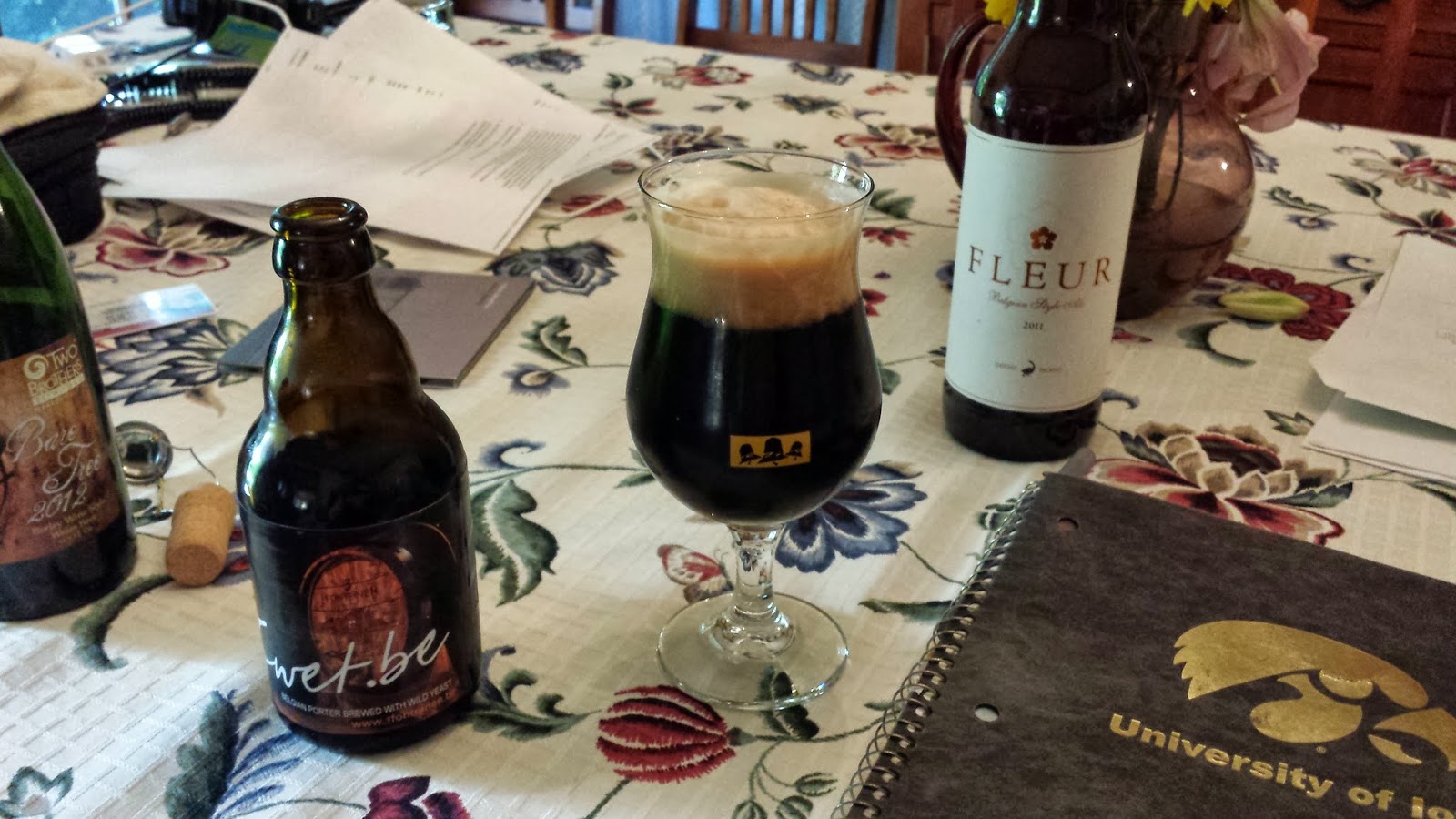
Unsurprisingly for a porter, it is pitch black.  The head formation and retention is spectacular---that two fingers of foam you see below stayed for 10 minutes without dissipating.  It also left excellent lacing afterwards.  Needless to say, this is well-carbonated.

If you have ever wondered what I use to write my notes on, that's it....I keep it old school and tablet-free.
Yup---stayed like that for ten minutes.  Nothing receded.

That tight, persistent cap of foam makes smelling this a bit of a challenge; most of the aroma is kept underneath it.  Having accidentally let my nose stray too close on a few too many occasions, I firmly believe beer is best ingested through the mouth, not the lungs.  The aromas are easier to discern straight out of the bottle.  Deep, earthy chocolate notes rule the day, a combination of the malt (chocolate) and yeast (earth).  I've never experienced a 3F lambic, so I can't say for sure whether this smells like their usual yeast, but the sweaty-gym-sock smell many lambics have is not here.

Zwet.Be tastes more elaborate than it smells.  A definite layer of chocolate and coco powder from the barley malt gives way to the somewhat subtle but unmistakable funktang of wild yeast.  I don't remember where I heard that word, but I like it.  I also think the phrase "sweaty apples" (my own invention) is a decent way to describe it, mixed with lemon peel and topped off with more tangy flavors. A rustic, mildly smoky flavor is there from something (probably the malt), which is odd for a second before you get used to it.  Vague hints of dark fruit round out the profile and remind the drinker that yes, this is a porter.  Sort of.

As I expected, Zwet.Be is funky but not sour.  It is creamy and utterly smooth, yet finishes semi-dry.  I have no way of knowing how fresh this is, but I would expect it to get drier with age.


This didn't last long once I finished writing my notes.  Unusual and not for everybody, but well-done.


Saturday, September 14, 2013

Dogfish Head Immort Ale


I wanted to like this beer a whole lot more than I did.  While I am a little iffy on the idea of a beer brewed with juniper berries (the one juniper beer I’ve tried was ghastly), the thought of a smoky oak-aged barleywine brewed with maple syrup, vanilla beans, and Belgian yeast sounds delicious.  There aren’t enough beers brewed with either vanilla or maple syrup.  I tend to like oak-aged beer, overall.  I enjoy smoked beers, particularly the campfire-and-bacon sort, but I am not opposed to peat-smoked beers either (I enjoy Scotch every now and then).  I never imagined it would be the smoke that would bug me.

The beer doesn’t look super intimidating.  It has a reddish-amber hue, more or less transparent.  The foam on top never gets beyond a film, though it does stay around for a decent time.  It also leaves some lacing, though not much.  I would like to take this time to pimp what is easily the best beer glass around.  Anyone who doubts that laser-etched nucleation points help with carbonation need only watch this:

Nice steady stream of bubbles.


Where this beer starts to go wrong is when I smell it.  I took one whiff and knew this was going to be an unfortunate experience.  Two words: BAND AIDS.  I have had many peat-smoked beverages.  A lot of Scotch whiskey is brewed with peat-smoked barley, imparting flavors as wide-ranging as ash and moss and medicine (like chewing on a tablet).  I generally like it, and the first Scotch I ever bought was this smoky beast.  But I have never, ever tasted Band Aid flavors in Scotch, or peat-smoked beer, despite both containing phenolic compounds commonly said to taste like band aids..  I thought it was a bad joke some brewers liked to tell; after all, who has actually tasted a Band Aid before?  I am sorry I ever doubted them.  This smells the way a Band Aid smells, and there is no other association I can think of.  It’s the only one that makes sense.

As the beer warms up, I can also faintly make out some vanilla scents.  But nothing strong enough to suggest this was brewed with vanilla beans, or for that matter aged in oak barrels, fermented with maple syrup and brewed with juniper berries.

The flavor is a little better, but not amazing by any stretch.  There is indeed some smoky Scotch-like flavor now, a hint of peat moss in there.  Also like Scotch---and not welcome in beer, as far as I’m concerned---is the prominent role the alcohol has in the flavor profile.  Somewhat pleasantly spicy but unpleasantly warming, it ends up going to war with the insurgent Band Aid flavor and I the drinker am collateral damage.  The combination feels like a continuous, unending M.O.A.B. strike on my tongue.  What little vanilla flavor here could have come from the vanillin naturally present in oak wood, they should have used more vanilla beans to make it distinct.  Also, they should have used less peat-smoked barley, or perhaps a different brand or grade of it.  There is still not a single note of maple syrup or juniper berries, and the beer finishes with a long-lasting aftertaste of heat, smoke, and Band Aids.

The texture isn’t doing this beer any favors either.  For an 11% barleywine, it has a drying quality to it that is almost parching.  The smoke and dryness coat the mouth for much longer than they are welcome.

The label tells me that I might feel immortal after having a bottle of this.  HAH---if only.  I feel like my palate has been fatally wounded.  Dogfish Head makes much better beer; this is one to avoid.

Friday, August 30, 2013

Goose Island Fleur 2011


When I was back in Illinois in late June (and again in late July/early August) I took full advantage of the many beers which are not sold out east.  I also cracked out a few bottles I have been saving in the basement.  One of these was a two-year old bottle of Goose Island Fleur, from April 2011.  They stopped making it later that year.

Fleur was sort of an oddity, a “budget sour.”  It wasn’t truly sour, just lightly tart (which is usually all I want in a sour anyway).  It started its life as a Belgian pale ale brewed with hibiscus flowers; after it was done fermenting, Goose blended it with kombucha tea, then bottled it with wild yeast.  Kombucha is a style of tea which naturally has small amounts of the types of bacteria which make sour beer acidic (along with a few other microorganisms), so this added a mild tartness to Fleur.  Despite the small amount of tea blended in, Goose Island made so much Fleur in 2011 that they were Illinois’ largest tea producer for that year (see about three minutes into this video).

When Fleur was fresh, it abounded with tea flavors, primarily flowers.  Within two months, there was a good balance between flowers, fruit flavors, and wild yeast.  By the time it was six months old it was quite dry and delightfully if only mildly funky, and a bit tart as well.  It didn’t change much for the next year.  This was one of my last three bottles, and I’m sad to see it dwindle down—largely because it still tastes excellent.


Fleur looks much the same now as it did when fresh, with one difference: the wild yeast has gone to work so well that it is now more carbonated than it was two years ago.  There was a loud hiss when I popped the cap, and the foam retained extraordinarily well.  It also smells much the same as it did a year ago.  Hints of strawberry and other assorted fruits from the tea mix well with the funk of wild yeast, which smells maybe a smidge stronger than it did a year ago.

There is a greater discrepancy in the flavor, but it is still recognizable as Fleur.  That berry-fruity tea sensation is still present, but it has been joined with stronger herbal/flower notes; almost like a perfume.  The yeast is tangier than in the past, an effect even more exaggerated by the high carbonation.  Tartness is about where it was when I last opened a bottle eight months ago.  I detect the slightest smell of what may be the beginning effects of oxidation.  As a whole, the beer is brighter in flavor than it used to be.

Apart from the potential onset of oxidation, the only downside here is the mouthfeel.  The increasingly aggressive carbonation, beyond what it used to be, has the effect of making the beer feel crisper and lighter than it should, borderline effervescent.  More disappointing, all the delicious flavors don’t linger very long; they slip off the tongue too quickly.  The airiness gives it an unnaturally clean aftertaste.

If anyone reading this has any bottles left over, or if you happen to stumble across a shop that kept them well-stored for the last two years, I would not hesitate to drink them.  What I would not do is buy them and hold onto them for a long time, as the beer seems to be changing.  It may still be tasty and interesting a year from now, but I don’t think it will taste like Fleur.

Friday, August 23, 2013

Sierra Nevada Ovila Abbey Quad with plums


Beers made by monks are held in very high regard in the beer community.  They are frequently cited as some of the best beers in the world, and most are pretty readily available.  The ones that aren’t are highly sought after.  Most are enjoyed fresh but they have a reputation of improving with age, particularly Westvleteren 12, Orval, and Chimay Blue.


The popularity of monk-brewed abbey ales has resulted in a slow but steady growth in the number of secular breweries trying to brew imitation beers.  This beer is the result of something a bit different.  In 2011 Sierra Nevada partnered with the monks of the Abbey of New Clairvaux in Vina, California to raise money for the rebuilding of an old rundown monastery.  The beers are supervised by the monks, utilize abbey brewer’s yeast, and are made with ingredients grown by the monks, but the actual brewing part is done by Sierra Nevada.  Basically, it’s a quasi-monastic twist on contract brewing.

This is an abbey quad brewed with sugar plums.  I had previously had the Ovila Dubbel.  It pours a chocolate-brown hue with minimal head formation or retention, though this is a ridiculously wide glass.  There's plenty of room for the foam to spread out.  Some lacing is present.  The beer is very opaque.


I thought the double had a good but odd aroma, very atypical for the style.  Whereas most doubles have some fruity combination of dates, figs, candi sugar, and spicy phenols, double was mostly chocolate, banana, and bubblegum.  Quads are basically the bigger badder brother of doubles and so I’m not surprised Ovila Quad with plums smells similar to Ovila Dubbel.  They both share dominant aromas of milk chocolate, banana, and bubblegum.  The quad also has notes of plums (obviously) and some date sugar, but both are more subdued.  Overall, a very similar aroma to the double.

The plums stand out more when I actually taste the beer.  The smell of banana and date doesn’t really translate into the actual taste of the beer, but that weird bubblegum flavor is still there.  A new flavor of spicy yeast shows up as well.  However, sweet chocolate is still the most prominent flavor, with plums and gum following it up.  Imagine chocolate-covered-plums-flavored chewing gum, with a dash of an unidentifiable spice on top.  Tasty, but weird and out of place in a quad.  The texture of Ovila Abbey Quad is pretty close to the real deal though.  Quads are generally very carbonated and comparatively dry given their alcohol content; most other beers in the 10% or higher realm are on the sweeter side of things.  Ovila is well-carbonated and finishes on the drier side of your typical quad.


This is a better beer than Ovila Dubbel.  However, I still wouldn’t rush out to buy this next year, assuming they make it again (they’ve been switching up the Ovila releases every year).  I also didn’t really feel like finishing the last two bottles in my four pack; I guess I’ll see if this will taste better in a year.

Friday, August 16, 2013

Two Brothers Bare Tree 2012


Name:                   TwoBrothers Bare Tree 2012
Style:                    Wheatwine
Twist:                   None
Strength:               11%


Notes: 12.7oz corked bottle, served into a John’s goblet/snifter, the kind they don't make anymore  Bought in either January 2013 or March 2013.  The recipe for this changes every year, as does the artwork.


Let’s hope this is better than last year’s, which was very undercarbonated.  Pours a golden-copper with minimal white foam despite the carbonation, which was ample.  Bare Tree typically tastes like a hefeweizen; this is darker than your standard hefe but not by much.  


The aroma is appetizing.  Wheat cracker and wheat bread with some notable spicy esters and clove.  Mild on clove, but a bit stronger on spice.  The typical weizen flavor of banana is lighter this year than the two past years.  There is something that smells a bit like the aroma you get when cracking a peanut.  There is possibly a hint of corn husk, and a very very faint fusel alcohol note.

The wheat cracker continues.  Taste is very grainy…this is the most malt-forward, least yeast-driven of the three most recent batches.  I taste Ritz crackers (complete with salt, at least in my mind), some more spice, pears or light apples, a bit of hop bitterness on the finish.  Pale malt, slight honey, and peppery yeast.  The texture is thicker than the carbonation would imply, but at no time does it feel like an impediment to drinkability. 

This is quite tasty, and a noticeable improvement over the previous batch.  The 2011 was completely flat and just tasted like a run of the mill hefeweizen, which is not something I would pay $8 for.  It has been too long since I tasted the 2010 batch, so I can’t really say for sure if I like it more or less.  I would imagine this would place second in a side-by-side of two fresh batches, were such a thing possible.  It lacks the apricot flavors the 2010 year had.

I enjoyed this.


This was written on June 28, 2013.  It was typed on July 22, 2013.