Friday, January 17, 2014

Kulmbacher EKU 28


Name:                 Kulmbacher EKU 28
Style:                   Doppelbock
Twist:                  None (just really strong)
Strength:            11% (!)


Notes: served in a snifter from an 11.2oz bottle with the indecipherable bottling date of “2329182.”

Nice carbonation on this one....


My first beer from this company is a bright red and surprisingly carbonated doppelbock.  The finely and tightly carbonated beer is nonetheless incapable of forming a sustained head, no doubt because of its strength.

“Liquid bread” as a description was practically invented for doppelbock.  It is a profoundly malty style, hearty without the oft-cloying sweetness of similarly malty styles like barleywine and imperial stout.  All beer is made from grains like barley and wheat, but of all the types of beers I have tried I would say doppelbock most closely resembles the flavors of the breads associated with it.  If its aroma is any indication, EKU 28 is no exception.  It is bready with a hint of toast and caramel, and possibly some alcohol.  I’m not much of a bread eater, so I’ll just say this reminds of me brown breads.

The taste of ethanol unfortunately plays a larger role than the mild aroma let on. It is not, however, a complete obstacle.  Ethanol-derived flavors of spices, heat, and rum add some balance to what  otherwise might be a very saccharine brew.  More brown bread, toasted bread, and some faint molasses let you know this is an actual imported bock, not a bad imitation.  I would prefer less toast, but mostly I would prefer less heat.  A faint apple-like flavor starts to creep out as this warms up.

Along with the alcohol heat, the carbonation keeps this from being cloying.  Actually, I’m tempted to say the carbonation and general texture of the beer are the high points.  Spritely carbonation is normally absent from a doppelbock.


Though this is considerably better than my least favorite doppelbocks, there are quite a few other doppelbocks I will reach for instead next time.  Interesting and could possibly improve with some age (to let the heat die down), but EKU 28 won’t be a regular purchase for me.  When it comes to stronger German bocks, Weihenstephaner Korbinian is still king in my book.


This was written as it was consumed on January 10, 2014.

Wednesday, January 8, 2014

Tilquin Quetsche (plum lambic)

Well, this one is a bit of an oddity.  A tasty sour oddity, that is.  Tilquin is not an actual brewery, but rather a blend-ery: they take the unfermented wort from lambic breweries in Belgium and then make up their own proprietary blends of 1, 2, and 3 year lambic.  Specifically, they use unfermented lambic wort from Cantillon, Boon, Girardin and LindemansThis particular beer is a blend of lambics aged in oak barrels with plums.


The cork comes off the bottle with quite a loud pop.  It doesn't take long to figure out why.  Some lambic is completely still (no carbonation), some borders on Champagne, and the rest falls somewhere between.  This one leans moderately towards the effervescent end of the spectrum.  A persistent crown of foam tops the plum-colored liquid.

Check out that best before date ten years out....


The aroma wets the appetite, to put it mildly.  The underlying classic sour lambic smell of Granny Smith apples and wet hay is no match for a veritable wave of fruity plum aroma.  A slight hint of white wine rounds things out.

Sourness in beer comes in a few different forms of varying intensity.  Fruity acidity of all kinds, vinegar-like acidity, mild cider tones, stomach churning, tooth-shredding intensity; there is a surprising variety of sour flavors and degrees of acidity.  Tilquin Quetsche is solidly in the fruity-puckering vein of lambic, and fairly intense.

A fruit lambic wouldn't be a fruit lambic without actual fruit, and this beer does not disappoint.  In addition to the expected tart apple/apple skin flavors found in all lambic, there is an abundance of plums.  Plum flesh, plum juice, it's all here.  Very juicy, bordering on Cantillon levels of fruit.  I can't imagine how many plums were added per barrel.

The texture is perfect for this sort of beer.  It is dry, light-bodied but not airy, and with a very appropriate level of carbonation.


After each sip, I rolled my tongue around the inside of my mouth, over my teeth, around my gums---similar to how one gets flecks of peanut butter off your teeth.  There was tart plum flavor everywhere for as long as ten minutes after my last sip.  Tilquin made a very elegant lambic here, even better than their unfruited one in my opinion.

Sunday, January 5, 2014

Brooklyn Monster Ale (2012)

http://beerstreetjournal.com/brooklyns-brewings-cat-monster-passes-away/


Name:                 BrooklynMonster Ale (2012)
Style:                  English barleywine
Twist:                  None
Strength:            10.1%


Notes: I had this beer in August of 2013, close to its one-year birthday.  Served in a Bavarian Lodge snifter glass.


Monster Ale was formerly a seasonal (fall/winter) release from Brooklyn, named after the brewery’s cat.  When the cat died last year they decided to retire the beer.  After grudging and grimacing through one bottle, I was amazed that it ever left Brooklyn’s quality control division---and sympathetic to the cat, who probably deserved a better namesake beer.  I also immediately regretted buying two packs to make sure I got a last chance to try this.

Brooklyn Monster Ale is brighter than the norm for a barleywine, bright red in hue with no opacity.  The slow, steady stream of fine bubbles can’t overcome the high alcohol content and (likely) low hopping level.  Head formation and retention are both low. 

Apart from being unusually bright and translucent, Monster looks normal for a barleywine.  Unfortunately, everything from this point onward is downhill.  No…that’s not really accurate.  If it was downhill, it would be an easy drink.  “Falling off a building and painfully impaling oneself, Saruman-style” is more accurate.

The aroma is sharply redolent of both caramel and pure ethanol, a staggering juxtaposition at once impressive and unwanted.  Undercurrents of metal and nail polish remover compound the problem.  I very much doubt that anyone in the history of beer drinking has ever said to themselves “I want a beer that smells like caramel dipped in bad vodka and spiked with Cutex,” which leaves me confused as to why a respectable brewer would try to make one.

The dearth of deliciousness in the nose leads to a cornucopia of failure on the tongue.  In the last year I’ve had a great number of beers stronger than Monster’s 10% alcohol by volume, some considerably stronger (up to 16% alcohol).  Examples include Samichlaus Helles, Samichlaus Classic, Two Brothers 16, Schmaltz Sweet 16, and Goose Island Bourbon County Coffee Stout.  Monster unquestionably integrates its alcohol worse than any of these, however.  The ethanol burn far outshines any other sensation, grating every corner of my now-grimacing mouth.  There is a faint hint of caramel, which is the only mercy Monster grants.  I also picked up a mineral note akin to hard water, which I am indifferent too.

The nail polish remover from the smell is blessedly gone in the flavor, but the persistent presence of tin-like metallic flavors convinces me Brooklyn fermented this way too hot.  There’s clearly some other alcohol besides ethanol in here.  Unexpected and unwanted hop bitterness doesn’t help, and neither does a style-defying dryness.  Barleywines are supposed to be sweet.  The combined effect of dryness and burning alcohol made mincemeat of my nightlong efforts to wash the aftertaste away.


That Brooklyn deemed it necessary to release this monstrosity is confusing.  That they named it after a beloved pet is inexcusable.  This is one retired beer I won’t miss.

Thursday, December 12, 2013

Goose Island Bourbon County Barleywine


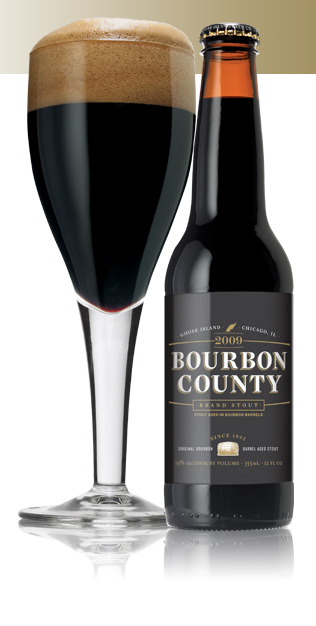
The picture you see up above is what I had on November 29, 2013, in celebration of my upcoming birthday.  It is Goose Island Bourbon County Barleywine. Every year since 1992, Goose Island has made a stout called Bourbon County Brand Stout (BCBS).  It is aged a few months to a year in bourbon barrels ranging in age from eight to sixteen years.  In 2010, they released a beer called BourbonCounty Rare: it was aged for two years in rare twenty-three year old bourbon barrels.  They liked the barrels so much they reused them to age a barleywine for a few months, which was released as King Henry in 2011. 

I do not expect to ever taste a beer, wine, whiskey, or any food (period) that tastes as good as King Henry did.  That beer was, is, and forever shall be legendary.  This particular beer is modeled after it: similar recipe, but aged in regular BCBS barrels.  So if you look at the ratings for King Henry, you can probably imagine the amount of hype this beer generated before release.  I am happy to say it exceeded my expectations even though it has not eclipsed King Henry (which is impossible). 


As you can see above, at first glance the appearance of Bourbon County Brand Barleywine (BCBB) is identical to that of a stout.  If you could reach into your computer screen, pull that glass out, and hold it up to the nearest light, you would see it is actually a little transparent.  Barely.  It is also moderately redder than that picture betrays.  It is decently carbonated like a fresh bottle of BCBS, but also like BCBS it is incapable of forming a coherent crown of foam for more than three seconds.  I don’t mind; a beer’s appearance is the least relevant part.

The aroma of BCBB suggests toffee dipped in chocolate, pecans dipped in chocolate (with more toffee), marshmallow, and molasses.  It’s all here.  Apart from the marshmallow, this doesn’t have that vanilla nose that King Henry had, but it is still recognizable as being cut from the same cloth.  Oak and whiskey are very, very subdued in the aroma; this smells like it absorbed more of the stout than King Henry did, hence the stronger chocolate aroma.  


I taste molasses, mild ethanol heat, whiskey and caramel up front.  The heat is more present than in King Henry, but in no way a distraction---it is far less obvious than it is in fresh BCBS.  The aftertaste of this beer is…not an aftertaste.  It’s an afterglow, the little bit of hazy color you see when you’ve been staring into a bright light for a few minutes and then turn it off.  Except instead of red and green and black dots in my eyes, it is flavors of toffee, vanilla, marshmallow, walnuts and milk chocolate.  All of those flavors mixed together make a great combination.  I would say milk chocolate slightly edges the others out, a result of the stout component, but it is distinct from a lot of other chocolate-like flavors found in stouts.  It resembles milk chocolate more than dark chocolate.
I could see this being almost too sweet after a year or two of cellaring, but this fresh the mild alcohol burn still keeps the sugar in check.  It also has enough carbonation to prevent the texture from being too thick.  Even without the carbonation, I don’t think this would ever be as thick as the stout is.  It lacks the oiliness of that beer.

This beer really is a treat everyone owes themselves a chance to try.  Given the crazy hype surrounding it I wouldn’t be surprised if it’s all sold out now since it has been out for the incredibly long period of…um, twelve days.  However, it was released in four-packs.  For Goose Island, that means they will make it again, probably every year.  Make sure to keep an eye out for it next November or December.

Tuesday, December 10, 2013

Goose Island Bourbon County Coffee 2013


Name:                 GooseIsland Bourbon County Coffee Stout (2013)
Style:                   Imperial stout
Twist:                  Aged in bourbon barrels, with a different coffee added every year
Strength:             13.4%


Well it’s been a few years since I’ve had this beer.  In fact, it’s been about three and a half years: I last had it the first year they released it, March 2010.  I thought it was…okay.  For a beer enthusiast, that pretty much makes me a heretic.  I just thought regular Bourbon County has enough roasted flavor plus whiskey heat on its own that adding another burnt ingredient (roasted coffee) just didn’t make any sense.  Since this year’s release is in a more manageable bottle format (12oz bottles instead of 22oz), I thought I would revisit it.  Also, this year it is made with a bourbon variety of coffee from El Salvador, which happens to be my favorite varietal (it has no relation to bourbon whiskey, FYI).

The appearance of Bourbon County Brand Coffee Stout (hereafter BCBCS) is, like all the Bourbon County variants, oil black with almost no foam whatsoever.  I’ve said it before and I’ll say it again: those pictures on Goose’s website of Bourbon County ____ with a huge three-finger head are completely, 100% Photoshop.  You will never get that much foam from anything Bourbon County, no matter how hard you pour it.  

What Goose Island wants you to believe every Bourbon County looks like, with sexy crown of foam.


What every Bourbon County actually looks like, with sad, depressing foam.


Despite the identical appearance, BCBCS’ aroma is markedly different from the standard Bourbon County.  It is also different from the fresh bottle I had back in 2010.  Either they added more coffee this year or this is just a really strong bourbon cultivar, because every whiff screams C-O-F-F-E-E at my nostrils.  There is a faint hint of molasses in the background and almost no whiskey, which greatly surprises me.  Regular Bourbon County practically oozes whiskey flavor when fresh.

The flavor has more of the typical Bourbon County characteristics that have made it so popular….with a giant scoop of coffee blended in.  Seriously, the coffee flavor really pops this year.  It overpowers the underlying base beer’s flavors of molasses and chocolate, which have almost no room here.  I can appreciate some oaky vanilla flavor but not much whiskey.  This beer tastes like marshmallow-flavored coffee.  It’s yummy, but a bit much.  In fact, it is so strongly redolent of coffee that I will not be surprised if I have trouble sleeping tonight.

The texture is classic Bourbon County: thick, somewhat oily and not particularly carbonated.  No surprises here.  The alcohol heat keeps the sweetness in check a bit, as it does with fresh standard Bourbon County.


Feel free to call me a heretic again, but while this year’s is good, I would still pick a smoother batch of the regular fresh; or any batch of the regular with age.  If you like coffee and stouts though, you owe it to yourself to seek this out.


This was written as it was consumed on December 10, 2013.

Saturday, November 2, 2013

Victory Oak Horizontal

Several years ago, Victory Brewing Company made a barleywine called Old Horizontal.  It was a moderately hoppy barleywine that was available during the winter in six-packs, a rarity for the style.  They put it on hold for a few years because they didn't have the space to brew it while they were expanding (they wanted to focus on their better-selling beers to finance the expansion).  They are bringing it back this year, but in between the early retirement and later this winter, they decided to do a special release: Old Horizontal aged in bourbon barrels.  This is called Oak Horizontal.


Obviously, it's been years since I had the original, so my memory is a bit fuzzy about how the beer looked.  I do remember it having a surprisingly ample carbonation for a barleywine, something this version retains; having a mild nose with little hop notes; and for having a more hoppy but still restrained bitterness in the flavor.  Also, I liked it.

The aroma of this particular iteration reminds me a little bit of Founders Backwoods Bastard, chiefly in the way the combination of bourbon and malt evokes cherries and vanilla.  There is a hint of toffee as well which distinguishes this from Old Horizontal, and I'm not sure if that's from the bourbon or mild oxidation.  The overall sensation is sweet, but not cloying.  Like Old Horizontal but unlike most American barleywines, the smell of hops is not detectable.

Also like Old Horizontal, the hops I couldn't smell are more than apparent once I actually taste the beer.  Unlike the base beer, however, the hops in Oak Horizontal do not add a pleasant bitterness for balance.  Instead, they clash with the barrel.  There's a reason most barrel-aged barleywines in this country are typically English (minimum hopping) in nature, and that is because hops and whiskey normally don't mesh well.  Here, the hops are actually stronger than the bourbon notes, overwhelming the burnt sugar from the whiskey as well as the vanilla from the wood.  The wood, regrettably, takes on a more astringent tannic character here.  Astringency and bitterness never work well together.  On the plus side, the cherry and toffee flavors are still prominent, and the beer's alcohol rarely shows itself.


Barrel aging beer is tricky.  Beyond the technical, time, storage space and potential bacterial concerns, beer requires a certain profile to do well in a barrel.  There's a reason many breweries don't release barrel-free versions of some of their beer, and it's probably because they're a mess without the time in the wood.  The corollary to that is beers which taste great without barrel aging won't always improve when brewers try to barrel age them, because they weren't designed with barrels in mind.  That seems to be what happened here.  The base beer is/was great without the bourbon barrel, and the hoppy aspect makes it unsuitable for barrel treatment.  It isn't bad, just worse than regular Old Horizontal.  Victory can't bring that beer back soon enough.